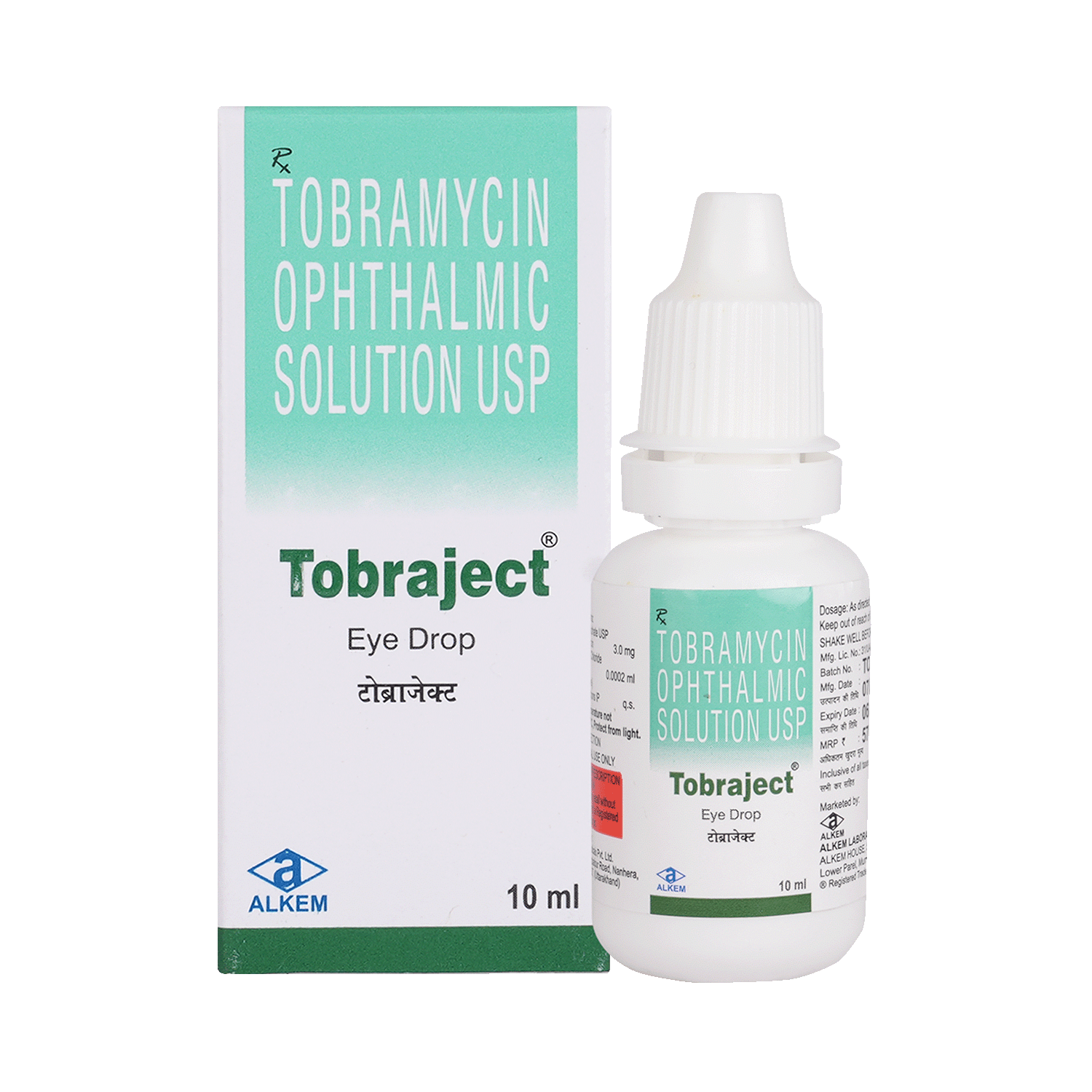
Tobmin 0.3% Eye Drop
bottle of 5.0 ml Eye Drop.Prescription required
About this product:
| Salt Composition: | Tobramycin (0.3% w/v) |
| Manufacturer: | Slash Lifevision |
| Storage: | Below 25 degree celcius |
Out of Stock
Have doubts about this medicine?
Have doubts about this medicine?
Tobmin 0.3% Eye Drop is an antibiotic medicine used to treat bacterial infections of the eye and eyelids, and to prevent infection after an eye injury or surgery. Tobmin 0.3% Eye Drop is an antibiotic medicine that is used to treat bacterial infections of the eye (e.g., conjunctivitis) and the eyelids (e.g., blepharitis). It may also help to prevent an infection after an eye injury or surgery.
Tobmin 0.3% Eye Drop is an antibiotic. It stops bacterial growth in the eye by preventing synthesis of essential proteins required by bacteria to carry out vital functions. This treats your eye infection.
What bacteria does Tobmin 0.3% Eye Drop kill?
Tobmin 0.3% Eye Drop effectively combats a wide range of bacteria. It is crucial to use Tobmin 0.3% Eye Drop only against susceptible bacterial species. The targeted bacteria include S. Aureus and S. epidermidis, some Streptococci species, Pseudomonas aeruginosa, Escherichia coli, Klebsiella pneumoniae, Enterobacter aerogenes, Proteus mirabilis, Morganella morganii, most Proteus vulgaris strains, Haemophilus influenza, and H. aegyptius, Moraxella lacunata, Acinetobacter calcoaceticus, and some Neisseria species. Consult your healthcare provider to determine the suitability of this medication for your condition.
How long should I use Tobmin 0.3% Eye Drop?
The duration of treatment will be determined by your doctor based on the severity of your infection. For mild to moderate infections, your doctor may advise using Tobmin 0.3% Eye Drops for 1-2 times daily for up to two days. In severe infections, a more frequent dosage of 2 drops every hour is recommended. Always use Tobmin 0.3% Eye Drop only as prescribed by your doctor and avoid exceeding the recommended dose or using it more often than instructed. Your doctor will guide you on how long to use the medication.
How should Tobmin 0.3% Eye Drop be used?
Before administering Tobmin 0.3% Eye Drops, thoroughly wash your hands to prevent contamination. Avoid touching the dropper tip against your eye or any other surface. Tilt your head slightly and instill one drop into the affected area of your eye. Ensure you close your eyes for approximately 2-3 minutes while keeping your head down. Do not blink or squint during application. Press a finger gently onto the inner corner of your eye to maintain contact between the medicine and the eye. If using multiple drops, wait at least 5 minutes before applying another drop. For complete medication administration, allow at least 10 minutes before applying any other eye medications prescribed by your doctor.
What if I don't get better after using Tobmin 0.3% Eye Drop?
If you do not experience improvement after completing the full course of treatment, inform your doctor immediately. If your symptoms worsen while using this medication, communicate it to your doctor as well.
Can I stop using Tobmin 0.3% Eye Drop when I feel better?
No, you should not discontinue Tobmin 0.3% Eye Drops before consulting with your healthcare provider. Even if you feel better, do not stop taking the medication early as it may potentially leave infections incompletely treated and lead to further complications. Therefore, please continue your prescribed treatment for the complete duration.
This medicine is for external use only. Use it in the dose and duration as advised by your doctor. Check the label for directions before use. Hold the dropper close to the eye without touching it. Gently squeeze the dropper and place the medicine inside the lower eyelid. Wipe off the extra liquid.
- Your doctor has prescribed Tobmin 0.3% Eye Drop to treat bacterial infections of the eye.
- Do not skip any doses and finish the full course of treatment even if you feel better.
- Tobmin 0.3% Eye Drop may cause damage to cornea on long-term use.
- Apply pressure on the corner of the eye (close to the nose) for about 1 minute immediately after instilling the drop.
- Wait for at least 5-10 minutes before delivering the next medication in the same eye to avoid dilution.
- Stinging sensation may occur for 1-2 mins. Notify your doctor if it persists for longer.
- Tobmin 0.3% Eye Drop may cause damage to cornea on long-term use.
- Make sure to use it within 4 weeks of opening the bottle.

Alcohol
No interaction found/established

Breastfeed
Tobmin 0.3% Eye Drop is probably safe to use during breastfeeding. Limited human data suggests that the drug does not represent any significant risk to the baby.

Pregnancy
Tobmin 0.3% Eye Drop is unsafe to use during pregnancy as there is definite evidence of risk to the developing baby. However, the doctor may rarely prescribe it in some life-threatening situations if the benefits are more than the potential risks. Please consult your doctor.